Tuesday, 14 March 2006

Didn't know about this place in Melbourne. It's for sale now - the contents are to be auctioned, anyway. Alas, it seems that they'll be scattered across the world rather than being able to be kept together, or in Victoria.
Melbourne Tank Museum
www.whitehat.com.au/Melbourne/ Museums/Tank.asp (another photo is at www.4wdonline.com/Mil/ Tanks/Centurion.html )
(03) 9796 8188
456 Belgrave-Hallam Rd
Narre Warren North
VIC, 3804
anzacsteel.hobbyvista.com/ Armoured%20Vehicles/australianshermansph_4.htm
Less-armoured vehicles, some in need of a restorer's care, at the Museum: www.oldcmp.net/mtm_1.html
Here's a site that shows the other vibrant world-class attractions of the area: www.australianexplorer.com/ tourist_attractions/ narre_warren.htm

Self-explanatory, this one: www.warmuseums.com.au/vicPlaces.htm
International Museum listing: www.afvnews.ca/museums.html

Wednesday, 8 March 2006

Opisthokonts

"Animals," despite a conflation in the common mind with "mammals" ("we saw plenty of animals, birds and fish!") refers to any multicellular animals, from rotifers to right whales. The vast majority of animals, by sheer numbers, are microscopic. Of those that aren't, the vast majority are arthropods, which comprise three quarters of all known living and fossil species ... The majority of vertebrates are fish. The majority of terrestrial vertebrate species are birds, and 96 percent of the remainder are lizards and snakes. About half of all mammal species are rodents. Almost half the remainder are bats. Of mammal species not rodents or bats, almost half are ungulates. Of primate species, more than half are monkeys, with almost all of the rest lemurs or lorises ...

This is a planet of bats and rats, of sparrows, of beetles and ants, but mainly — to a first approximation — this is a planet of bacteria...
I find this point of view exhilarating, like looking at a starry sky and imagining the impossible distances. There is grandeur in this insignificance. There is an imperative not to take more than our share...
once we set ourselves apart from the rest of "creation," we begin to resent our ties to the earth. Of what importance is a snail, a rotifer, a tiger? We begin to imagine — and to implement — a world in which we are alone.

It is called hubris. It goeth before a fall, already in progress.

... We each of us are cooperative projects of a quadrillion or two prokaryotes, and those single cells conspire to create consciousness. It is as if pond scum, piled and shaped a certain way, began to discuss its purpose.

... We are the quintessence of dust and yet we are as gods in apprehension, and that's the whole point, and that's the whole problem.

Posted by Chris Clarke on 01/03 at 08:59 AM

Sunday, 5 March 2006

A little twisted
simulatedcomicproduct.com

Tuesday, 28 February 2006

mmmmm ... Pancakes!

Mardi Gras doesn't mean "goodbye meat". Carnivale does. Shrove Tuesday is something different again.

French
Lundi — Monday
Mardis — Tuesday
Mercredi — Wednesday
Jeudi — Thursday
Vendredi — Friday
Samedi — Saturday
Dimanche — Sunday


Gras - fatty, greasy; fat (noun) - as in the stuff inside sausages, etc.
Foie = liver, e.g. cirrhose du foie = cirrhosis of the liver, huile de foie de morue = cod-liver oil
Pate = paste (noun, e.g. pate a bois = wood filler) or mixture
pate de foie gras = mashed-up paste made from fatty liver

Mardis gras = greasy/fatty Tuesday


Latin
carne = meat or flesh (carnal desires, chile con carne = chile with meat)
vale = farewell (usually seen in eulogies, funeral orations as "Vale [whatsisname]"
This is usually anglicised as just 'carnival', and has come to mean things related to the time of 'misrule', celebration & so forth that happened before the start of Lent.

I guess in Europe that would have been at the miserable fag-end of winter, just when it was starting to turn so you could see spring on the way. I've heard a few Europeans say that February was the worst month usually, so a bit of a break-out could be a good idea - something to look forward to, something to work the last demons of darkness out of the spirit before you settle down for the haul to Easter.


English
Note, 'shrove' is like 'shrive', as in 'short shrift' - that is, absolution after confession . Because you'd be shriven before attending the very serious Ash Wednesday mass for the beginning of Lent. Maybe you'd do it at the end of the day, after letting loose earlier.

"What do you read, my lord?" "Words, words, words."

Delicious Library [MAC software]
Point any FireWire digital video camera, like an Apple iSight®, at the barcode on the back of any book, movie, music, or video game.

The barcode is scanned and within seconds the item's cover appears on your digital shelves filled with in-depth information downloaded from one of six different web sources from around the world.

Once your whole library is catalogued, you can browse, sort, and search through your digital shelves. Sync your catalogued library onto your iPod or print a color catalogue and take it with you.

Find and purchase new items using Delicious Library's personalized recommendations. Keep track of the items your friends are borrowing using Delicious Library's loan management system, which integrates with Apple's Address Book and iCal.

Take advantage of new, cutting-edge Mac OS X Tiger features with Delicious Library. Search though all of your library data using the Spotlight menu and enjoy anytime access to your entire collection with the Delicious Library Dashboard widget.

If you have tons of items, or don't want to have to take your items to your computer to scan them in, check out our wireless scanner.


Library Thing
www.librarything.com
Catalog your books online
Easy - Catalog your books online, or just keep a reading list.
Social - Show everyone your library, or keep it private. Find people with the same books as you. Get recommendations from readers like you.
Powerful - Search Amazon, the Library of Congress and 30 other world libraries.
Tagged - Tag your books as on Del.icio.us and Flickr (eg., wwii, magical realism, sexuality, christian living, cats).
Safe - Export your data. Import from almost anywhere too.
Free - Enter 200 books for free, as many as you like for $10 (year) or $25 (life).

BookSleuth®
forums.abebooks.com/abesleuthcom
Is there a special book that you read, or perhaps had read to you, at some point in your life but you can't remember the author and title? Perhaps you know the plot, or a character, or maybe even what the front cover looks like. BookSleuth® is here to help you find that book! Simply post a short description of what you can remember here on our board. Visitors from all over the world will read your post, and one of them is bound to know exactly what you're talking about and post a response.

Not missing anything? Why not see if you can help anyone else find their long-lost books?

Thursday, 23 February 2006

Sea Launch (Echostar) et al

An unusual tourist destination?
www.sea-launch.com
It's good to have a hobby.
www.flickr.com/photos/minifig -- We can't all be working in soup kitchens or cultivating gardens or creating great works of art in our spare time :)

Something in Extremely Bad Taste Indeed.
www.videosift.com/story.php?id=128

OK, OK, back to work

Croc on loose in Sydney

<em>February 23, 2006</em><blockquote>Northern Beaches police have been called to a waterway at Cromer after receiving reports a crocodile was sighted eating carp in a natural spring in an industrial unit block on South Creek Road.

Australian Reptile Park operations manager Craig Adams, who saw the reptile last night, identified it as an estuarine crocodile, commonly known as a "saltie".

The species is responsible for all fatal crocodile attacks on humans in Australia and can grow to at least six metres. Mr Adams said "If I was going to speculate, I'd say a kid's chucked it in there who got it off a mate, who got it when he was up north and brought it home as a hatchling, held onto it for a while and then maybe (his) dad said, `look, you've gotta get rid of that'."

He said it would be a "wonderful attraction" for a northern beaches cafe. "(But) it just won't survive the winter unfortunately."

The small crocodile is believed to have spent several months at the natural spring, surviving on a plentiful supply of carp and managing to evade any attempts to catch it. The croc's digs are located at the front of an industrial unit block, and visible from the street.

Cromer cafe owner Silvano Morello, who first spotted the crocodile, was among dozens of people hoping for a glimpse of the eatery's newest neighbour today. Ms Morello said her friends thought she was mad or "had had too much to drink" when she first mentioned the sighting.

Schoolchildren squealed and mums and dads took photographs with cameras and mobile phones today as the reptile teased the crowd with brief moments above the water and on the bank.

Police working with Australian Reptile Park staff were unsuccessful in catching the crocodile last night, but will make another attempt tonight

Once captured, the reptile will be placed in a suitable animal park.</blockquote>

Wednesday, 22 February 2006

Macrocosmos; Microcosmos

The Universe as a Human Body:


Schramm's figures for relative abundances indicate that helium is about 25% by mass and hydrogen about 73% with all other elements constituting less than 2%
[NB, I assume this is non-dark-matter, 'baryonic' I believe it's called, because we don't really know just what the 'dark matter' is, if in fact it's there.]

If a person weighs, say, 80kg & <koff&> virtually none is Helium, there's a fair chunk of Hydrogen, as part of carbohydrates (sugars, starches, alcohols, etc), hydrocarbons (fatty stuff), and the rest &mdash; most of a body &mdash; is made up of the 2% of the universe that isn't either of those. But if I were 80kg, and also The Universe (not counting Dark Matter, which may be my deep secrets and despair, or unconscious mind, or perhaps my spirit or soul), 2% of me would be 1.6 kg (~3.5 lb). Maybe a forearm, or both forearms, or a leg below the knee? I wonder how long a chunk of intestines would weigh that (empty of course). Which would be all the elements and compounds we know apart from hydrogen & helium.

Should I mention that a fair chunk of every human body is non-human cells? Bacteria & protozoa that we carry about on & inside ourselves. Not a particularly large amount by weight, but a lot if you count each human cell as equivalent to a single bacterium or single-celled protozoan.

Also see
imagine.gsfc.nasa.gov/docs/ ask_astro/answers/971113i.html (one of the answers in Goddard Space Centre's "Ask an Astrophysicist" section - imagine.gsfc.nasa.gov/docs/ask_astro/ask_an_astronomer.html

Cosmology - Birth and Death of the Universe
physics.gmu.edu/~jevans/ astr103/CourseNotes/Ppt/ Lec09_pt2_cosmologyModern/ tsld001.htm

Significant Eras back to Big Bang

    Present era = 10 -20 x 109 years after big bang
    Matter era = <106 years after big bang
    Radiation era = 1 s to 106 years after big bang
    Lepton era = 10-4 to 1 s after big bang
    Hadron era = 10-4 to 10-23 s after big bang
    Quark era = 10-23 s to 10-43 s after big bang
    Planck era = earlier than 10-43 s


An independent media collective at the University of Connecticut
Perhaps these people can find themselves in the line of descent of New Journalism
uconnfreepress.org


UConn Free Press is an alternative student-run newspaper. We are an anti-profit weekly publication serving the university and local community. We are dedicated to carrying out the tradition of participatory democracy through staff consensus in all matters concerning the paper. We welcome article and art submissions via www.freeuconn.com or uconnfreepress@gmail.com. Consider, criticize, and debate.

Music, Theatre & Dance: A Performing Arts Digital Library

The Library of Congress » Performing Arts Reading Room

This Web site, formerly known as "I Hear America Singing," invites visitors to experience the diversity of American performing arts through the Library of Congress's unsurpassed collections of scores, sheet music, audio recordings, films, photographs, maps, and other materials.
www.loc.gov/rr/perform/ ihas/lcp-home.html

Search Individual Collections
Civil War Sheet Music - lcweb2.loc.gov/cocoon/ ihas/html/civilwar/ civilwar-home.html
A collection of over 2500 titles of music about the Civil War.
Volcano of Delight: Historic Sheet Music, 1800-1922 - lcweb2.loc.gov/cocoon/ihas/ html/volcano/ volcano-home.html
A collection of over 9,000 titles published in the U.S. and Europe.

View Other Special Presentations ...
[includes currently]
A Jazz and Blues Filmography by David Meeker,
lcweb2.loc.gov/cocoon/ ihas/html/jots/ jazzscreen-home.html
a searchable database documenting the work of some 1,000 major jazz and blues figures in over 14,000 cinema, television and video productions.

Ask a Librarian - www.loc.gov/rr/askalib/ask-perform.html

Labour Music links (mp3, rm, midi, & links to lyrics): www.marxists.org/subject/art/music/index.htm

Sheet Music to "International" (1870) : www.marxists.org/subject/art/music/internationale.pdf [PDF]

Esperanto version: www.uv.es/pla/red.net/intesper.html

Listen to the most festive rendition of "The Internationale" ever ( mirukashihime.cool.ne.jp/sound/int_sfms.mp3 [MP3] ), played by a Japanese band Soul Flower Mononoke Summit ( www.breast.co.jp/soulflower ). Sort of a Japanese Klezmer version. Here are the lyrics written in in Japanese mirukashihime.cool.ne.jp/ sound/interjap2.GIF
( via Literary Montages)

This is a good source for the lyrics in parallel versions in several languages, including Asian ones.
The Internationale
(from en.wikipedia.org/wiki/The_Internationale )

Note there are also links here to Writers & other forms of art.

Another Year Gone

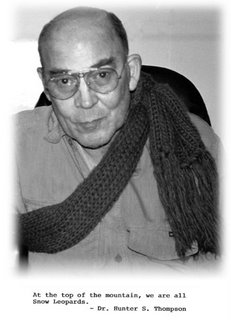
Hunter Stockton Thompson
    *18 July 1937
    +22 February 2005

Chief Gonzo

HST
Terms of Use [PDF]

San Francisco Chronicle's coverage last year

Fear, Loathing, and Great Reporting


Dr. Hunter S. Thompson is most remembered for over-the-top writings and personality. But it's worth remembering that he was also a damned fine reporter, with a gift for details and one of the best crap detectors in history.
by Sam Smith
(February 22, 2005)
-- One of the brightest lights in the American firmament blinked out Sunday. Word of Hunter Thompson’s death arrived at our house via the crawl on the network happy news this morning, and there’s irony enough in that fact alone.

Hunter Stockton Thompson, the Good Doctor, is most remembered for his over-the-top tours des excès – "Fear & Loathing in Las Vegas" being the most famous. But it’s not the gonzo high spots I’ll remember him for. What has gotten so lost in the legend that Thompson became (and the self-parody he sometimes lapsed into later in his career) is that he was a damned fine reporter.
Forget gonzo for a second. Before HST became an icon of the New Journalism he was an exceptional practitioner of a more conventional journalism, something that’s evident to anybody who’s read the early works collected in "The Great Shark Hunt: Gonzo Papers, Volume 1."

Thompson had a gift for the details and one of the best crap detectors in history. His flawless nose for the truths, dynamics, and motivations driving the players starring in his stories lent those narratives a quality that somehow fused unflinching naturalism with sweeping mythology.

Read "A Southern City with Northern Problems," for instance, where Thompson examines the issue of race in his native Louisville:
"The white power structure has given way in the public sector, only to entrench itself more firmly in the private. And the Negro -- especially the educated Negro -- feels that his victories are hollow and his 'progress' is something he reads about in the newspapers. The outlook for Louisville’s Negroes may have improved from 'separate but equal' to 'equal but separate.' But that still leaves a good deal to be desired."
Read "Hells Angels," Thompson’s landmark study of one of America’s unique subcultures. This wasn’t just exceptional journalism, it was some of the best scholarship I’ve ever read. It was ethnography, the anthropological study of cultures, and whereas some anthropologists study the rites, rituals, and folkways of natives in exotic faraway jungles, Thompson studied the rites, rituals, and folkways of natives living in exotic faraway Oakland, Calif.

Read "Fear & Loathing on the Campaign Trail," which remains perhaps the greatest political book I’ve ever encountered. While Thompson became famous for harpooning Nixon -- "a swine of a man and a jabbering dupe of a president [who] was so crooked that he needed servants to help him screw his pants on every morning" -- "Campaign Trail" made clear that you didn’t have to pick sides. He lashed on the Democrats more violently than he did Nixon, in fact. And for good reason. There’s plenty of ineptitude and corruption in both camps, it turns out -- a lesson America circa 2005 would do well to learn.
As tragic as Thompson’s death is -- has there been a time when we needed his honesty and brutality more than we do now? -- I was somewhat heartened by the explosion of tributes around the Web yesterday. My e-mail box was buried by individual notes and list mailings from all directions, with some issuing from journalists saying they’d never have become reporters in the first place without his influence. Almost every blog I checked had, at the very least, a link to an obit, which is more than appropriate given how important, how absolutely essential the pioneering work of people like Thompson and Wolfe has been to the brand of interpretive journalism being practiced in the more enlightened corners of cyberspace.

Further, his death arrives at a moment when the journalism industry is finally starting to contemplate issues that Thompson was railing about four decades ago. A number of very serious figures in the field have recently begun examining the repeated failings of objectivity in the press, with one -- Geneva Overholser of the Missouri School of Journalism -- telling The Hartford Courant that 2004 was "the year when it finally became unmistakably clear that objectivity has outlived its usefulness as an ethical touchstone for journalism."

Hunter tried to teach us that objectivity is a rule set that can be gamed, corrupted, and shaped into a weapon for use against the very principles it was developed to protect. He tried to teach us that fact and truth aren’t the same thing. Quoting Faulkner, he noted that "the best fiction is far more true than any kind of journalism -- and the best journalists have always known this." He set an uncompromising determination to get at the truth ahead of what he saw as artificial rules and conventions, and if the "facts" got in the way of the truth, well, that told you something about the facts, didn’t it?

Although I never heard him say it in these words, Hunter S. Thompson I think understood the artificial Red/Blue, Conservative/Liberal divide that most Americans seem to have bought into for the cynical construction that it is -- a rhetorical fluff job that turns Americans with common cause against each other and that serves the power elites in both parties to the detriment of the public they take turns fleecing.

In short, Hunter Thompson was a champion of the common people. Yes, his reporting was so crazed at times that you couldn’t be sure if you were reading an eyewitness account or a drug-addled hallucination. But he remained to the end one of the most unswervingly ethical reporters of our generation, a man whose commitment to social justice and the public good trumped everything.


Saturday, 18 February 2006

Log-Dump - the raw material

This summary is not available. Please click here to view the post.

Thursday, 9 February 2006

Different ways of looking at the world

Gridded Population of the World (GPW) page
www.ciesin.org/datasets/gpw/globldem.doc.html
Summary
Demographic information is usually provided on a national basis. But we know that countries are ephemeral phenomena. As an alternate scheme one might use ecological zones rather than nation states. But there is no agreement as to what these zones should be. By way of contrast global environmental studies using satellites as collection devices yield results indexed by latitude and longitude. Thus it makes sense to assemble the terrestrial arrangement of people in a compatible manner. This alternative is explored here, using latitude/longitude quadrilaterals as bins for population information

You can get the actual data, or look at the maps with population densities superimposed: The World in GPW


Dataset Variables
There are four files in this dataset - population counts (i.e., the number of people in each cell), population density (i.e., people per square kilometer), global population (counts, smoothed), global population (population density, smoothed.
The data are available as ASCII files or as pkzip compressed ArcInfo Export files
Each format is available as a global coverage, or as one of five subsets: North and Central America, Latin America and the Caribbean, Africa and Europe, Asia, and Australia, New Zealand, and Oceania

Archival and Access Information
GPW v1 is archived and distributed by the Socioeconomic Data and Applications Center (SEDAC) and is available via ftp at www.ciesin.columbia.edu/datasets/ gpw/ftpgrid.html. More recent versions of GPW are available at sedac.ciesin.columbia.edu/gpw.

Do-It-Yourself Mapping
www.gpsvisualizer.com
GPS Visualizer is a free, easy-to-use online utility that creates maps and profiles from GPS data (tracks and waypoints), street addresses, or simple coordinates. Use it to see where you've been, plan where you're going, or visualize geographic data (business locations, events, customers, real estate, etc.).
GPS Visualizer can draw maps in JPEG and PNG format in addition to SVG. These bitmapped graphics aren't nearly as versatile, but they don't require a plug-in

Geotagging on Flickr
flickr.com/photos/steeev/27164700
A snapshot taken on 11-Jul-05 of the locations at which 30222 geotagged flickr images were taken.

Trompe l'pedestrian

rense.com/general67/street.htm
Julian Beever is an English artist who works on the pavements of England, France, Germany, USA, Australia and Belgium. Its peculiarity? Beever gives his drawings an anamorphic view; his images are drawn in a way which gives them a strong illusion of three dimensionality when viewed from the correct angle.

A famous 'Old Master' using the anamorphic method is Hans Holbein's The Ambassadors — Jean de Dinteville and Georges de Selves — (1533), at the National Gallery in London
plus.maths.org/issue33/ features/dartnell_art — see this Zipped PowerPoint presentation ( www.virtualartroom.com/ presentations/ Anamorphosis.zip ) from an educational site www.virtualartroom.com/ interactive_exercises.htm. This ( www.constant.irisnet.be/ ~peter_w/ log/ index.php?p=20 ) talks about it too. The page is a bit wonky, but it does have a good picture of the anamorphic section of the painting as it looks at the 'right' angle, which is fairly rare.

Wednesday, 8 February 2006

Strange, yet True

Lynette Cook's art site – (Space section)
extrasolar.spaceart.org/space.htm

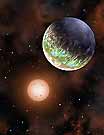
M Star Planet An M Star Planet (not completely unlike Earth)

United Nuclear sells many fascinating things (if you're in the USA)
www.unitednuclear.com/aerogel.htm

Sound from the Roger Rick & Marylin Morning Show witnessing by mobile phone (via wales can be interesting)

Self-Propelled Film-boiling Liquid Droplets
darkwing.uoregon.edu/%7Elinke/res_droplets.html
darkwing.uoregon.edu/%7Elinke/supporting
Film-boiling: When a drop of liquid is placed on a surface held at a temperature much higher than the its boiling point (such as a drop of water in a very hot pan) it hovers on its own vapour cushion, without wetting the surface.
This page links to a series of video clips showing a series of such droplets moving at speeds of several centimeters per second on asymmetrically structured surfaces. It can look both strange and rather beautiful.
darkwing.uoregon.edu/ %7Elinke/ supporting/ Movie4.mov
Some of the droplets are liquid nitrogen, which is above its boiling point at 'normal' room temperature.

This page on Brownian Motors relates to similar phenomena. It can relate to understanding how cells transport things within or around them, and might be useful in designing nanotechnology.

Friday, 3 February 2006

Just. Stay. Down.

Over at Kung Fu Monkey there's a great little take-down of some bloke's comments on recent Academy Award nominations. I won't spoil any of the fun quotes, except to say that later on the author wrote in the comments "some of the rhetoric is a bit 5 am-ish".
Go and Enjoy.

A Pale Blue Dot, seen close

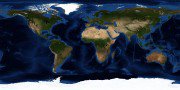
From NASA's Earth Observatory Newsroom: The Blue Marble Next Generation (part of "Visible Earth") is a series of images that show the color of the Earth’s surface for each month of 2004 at very high resolution (500 meters/pixel) at a global scale.

An important part of NASA's mission has always been to explore, to discover, and to understand this world from the unique vantage point of space. They now operate 18 of the most advanced Earth-observing satellites ever built. We can share these newly gained perspectives too, and this project is a good way of doing that.

The original Blue Marble was a composite of four months of MODIS observations with a spatial resolution (level of detail) of 1 square kilometer per pixel.

These new monthly images reveal seasonal changes to the land surface: the green-up and dying-back of vegetation in temperate regions such as North America and Europe, dry and wet seasons in the tropics, and advancing and retreating snow cover.

From a computer processing standpoint, the major improvement is the development of a new technique for allowing the computer to automatically recognize and remove cloud-contaminated or otherwise bad data—a process that was previously done manually. The ability to create a digital image that provides great detail in darker regions, such as dense tropical forests, without “washing out” brighter regions, like glaciers, snow-covered areas, and deserts is another of the key improvements,

Pale Blue Dot
Another picture of our planet. From more than 4 billion miles away.


And, comparatively close by ...
Space4case Mars Gallery 2006 - Recent 3D renderings of the surface of Mars. Beautifully done.

    [NB: The original linked from here is ... considerably larger. You might prefer to look in the Gallery linked above first.]


A personal site mostly using the Terragen landscape generating software. The artist, Kees Veenenbos, has also tried images of other parts of the Solar System, and had a go at depicting a view near a known extra-solar planet.

Thursday, 2 February 2006

By the world's most isolated ATM

On a table in the restaurant by the harbour in the town of Hanga Roa on Easter Island is this, which can apparently not be bought at any price, according to this note.

Saturday, 28 January 2006

Spam-enabled Humour

Mike Carlton's take on the AWB Oil-for-Food investigation
DEAR Madam/Sir

"Complements of the day, before I proceed, I must be grateful to introduce myself. I am Mrs Gaylene Hopsack, the bereaving widow of Honourable Neville Hopsack, a respectful high executive of Australian Wheats Board (Cayman Islands Inc). Due to an unfortunate clerical error, late Neville and Wheats Board deposited sum of $A300 million into bank account of Excellency Saddam Hussein, former President of Iraq (Bank Gnome Suisse de Zurich et Geneve) in respect of wheat export facilitation transaction.

"Enquiries in my home country of Australia proving difficult at present, I am seeking your assisting in repatriation of said funds in joint venture as imediately as plausible to our mutual benefit. I am ready to give you a good percentage for your helpfulness.

"As you are aware, Australian Wheats Board is an organisation of highest reputation, under supervision of Australian Canberra Government and United Nations' oil for foods program in Iraq. Therefore you must have confidence.

"Please provide your phone numbers and bank account details by return email with view to arranging friendly meeting in Australian financial capital city Wogga Wogga.

"Best regards, Gaylene Hopsack."

The legacy of Nev's misplaced millions
By Mike Carlton
January 28, 2006

It was good to smile at a rather dark time.

Assorted Kinds of Creation

Costume history reconstruction
www.virtue.to/articles/butterfly.html
For the Head
www.virtue.to/articles/arnolfini.html"

The Hands That Sew the Sequins
By ELIZABETH HAYT
Published: January 19, 2006

www.nytimes.com/2006/01/19/fashion/thursdaystyles/19ATELIERS.html
EVERY day for the last three weeks in Montmartre, 45 seamstresses at the House of Lesage, France's oldest embroiderer, have been hunched over wooden frames feverishly stitching sequins, rhinestones and beads onto gossamer cloth. Their needlework is so intricate it seems spun from candied sugar.
[Part of a very old tradition]

Various garments & accessories available here
www.sock-dreams.com/_shop/ pages/accessories_cat_CategoryID_74.php

Frilly

www.sock-dreams.com/_shop/ pages/accessories_detail_ProductID_346.php
www.sock-dreams.com/_shop/pages/ latest_product_detail_ProductID_598.php
www.sock-dreams.com/_shop/pages/ accessories_cat_CategoryID_95.php


www.sock-dreams.com/_shop/ pages/latest_product_detail_ProductID_564.php

including this idea:
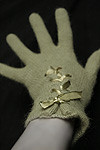
Pantyhose Love Glove - Makes putting on pantyhose a pleasure. Prevents snags, tears & rips on pantyhose caused by jewelry, jagged nails & dry skin. Perfect for handling and washing fine fabrics too. Smooth nylon tricot is resistant to snagging. One size, stretchy lace trim. $7.00

HTML 4.01 Entities List
www.w3schools.com/tags/ref_entities.asp
EUR sign € (&euro; or &#8364;)
The em-dash, &mdash, coded &mdash;
The copyright sign, ©, coded &copy;
Freedom of … intercourse (&2026;)

the original online Flanders and Swann resource
www.nyanko.pwp.blueyonder.co.uk/fas

Another exciting wrist-top timekeeper!
www.thinkgeek.com/gadgets/watches/7d2b
Possibly amusing
www.livejournal.com/users/misia/923747.html

Thursday, 26 January 2006

Cleek: Monday Cat Blogging

Needed a bit of cheering up.

Cleek: Monday Cat Blogging (Monday, January 23, 2006 at cleek.blogspot.com)

Tuesday, 24 January 2006

Heraclitean Art?

Ferrofluid is a material originally developed by NASA.


It is now being used for a range of practical devices, including dampers for controlling and stabilizing large buildings that move around in the wind. But it also has lovely visual qualities when magnetized, which some people are using for artistic purposes.

Ferrofluid sculpture


Sachiko has taken the idea of "liquid architecture" literally with these sculptures made from Ferrofluid, which changes its state by the introduction of electro-magnetic waves.
Here are pages with some still pictures,

and also videos of the changing effects:


and, in a different form of fluidity,
Australian digital artist Pierre Proske (www.digitalstar.net) is working with researchers at the Future Applications Lab of the Viktoria Institute in Sweden to develop intelligent fridge magnets ( www.viktoria.se/fal/interns/summer05/poetry). Each fridge magnet consists of a 16-character liquid crystal display, which may one day be able to fix bad grammar and change the words to something it thinkd is more appropriate. Mr Proske says "The idea is that each magnet is aware of the other magnets on the fridge and they transmit information between each other". He explains this is a "whimsical and accessible" way to contribute to the study of developing intelligent robots.

Mr Proske and colleagues have so far half developed a prototype intelligent fridge poetry magnet system and are hoping to get more ideas at the International Conference on Intelligent User Interfaces ( www.iuiconf.org/06program.html) in Sydney during January 2006.
Heraclitean? (see these: 1, 2) Πάντα ῥεῖ καὶ οὐδὲν μένει
Everything flows, nothing stands still

Wednesday, 18 January 2006

Not the Granville Train Disaster

War has broken out between Great Britain and Germany."
This was the message received by the Australian Naval Board, from the British Admiralty on the 5th of August 1914, at 1100 (11 AM) Australian time ( ahoy.tk-jk.net/MaraudersWW1/Postscript.html)
German ship in Melbourne when WW1 dawns
On the day war broke out, there was one German ship in Melbourne, it was the 6,560 ton steamer Pfalz, which had taken on board the Consulate staff from Melbourne, and was proceeding down Port Phillip Bay to pass through the heads, into the freedom of the open sea.
Captain Robinson was the Australian pilot navigating this vessel towards the Rip.
Port Phillip Bay, is a large body of water, but it narrows at the entrance, and is overlooked by protecting Forts on each side of the entrance, these two areas are collectively known as the Heads.
The morning war was declared by Britain on Germany, the Forts situated each side of the Bay, and guarding the Rip, were warned that Australia was now also at war with Germany.
The first shot to be fired by Australia in WW1, came from a 6 inch gun emplacement at Queenscliff, it was aimed across the bows of Pfalz as she was about to enter the Rip. Captain Robinson now observed the signal flying at the Fort, was against the vessel he was piloting, notwithstanding an argument with the German Merchant Captain, Robinson prevailed, he turned Pfalz about, and sailed her back to Melbourne and captivity.
A subsequent inspection uncovered 4 inch guns stowed in her hold, plus evidence came to light that this ship had been built to enable these guns to be mounted to turn her into an Armed Merchant Ship. It had been a close run thing!
The Germans now became Prisoner's of War, and Captain Robinson barely escaped the title of " Australia's first POW of WW1."


http://users.netconnect.com.au/~ianmac/coastal.html
The first shot of World War 1 by any allied army is supposed to have been fired from Point Nepean fort at Port Phillip Heads. The date was 5 August 1914, and the war was just one day old. The target was the German steamer Pfalz which was attempting to leave the port.

When she left Melbourne, news that Britain had declared war had not yet reached Australia. But that news had come through by the time Pfalz had reached the Heads. A shot fired ahead of the ship prompted wrestling over the engine-room telegraph control between the ship's Master and Melbourne Pilot Captain M. Robinson of Williamstown, followed by a quick reversal of course. The ship returned to anchor off Williamstown. More than five hours passed after the incident before the crew realised why the vessel had been fired upon and detained.

Pfalz was fitted out as a troop transport, and renamed H.M.T. Boorara.

The first shot of the Second World War is believed to have been fired from the same spot--Point Nepean--at a passing German ship--ss Stassfurt--which refused to stop and escaped.


Lesser-Known Facts of WWII
members.iinet.net.au/~gduncan/facts.html
FIRST ALLIED SHOT
The very first Allied shot of the war in the Far East was actually fired over the bows of the Australian coaster Woniora (Captain F. N. Smale) from a 6-inch gun emplacement at Point Nepean, guarding the entrance to Melbourne's Port Phillip Bay. The 823 ton coaster had entered the bay at 9.15 pm on September 3, 1939 after a trip from Tasmania. Ordered to heave-to for inspection, the coaster gave her identity but continued on without stopping. A 100 lb shell, fired across her bow, soon changed her captain's mind.

By a remarkable coincidence, this was the actual, same gun that had fired the first shot of World War I when, hours after war was declared, it fired on the German Norddeutscher Llyod 6,500 ton steamer Pfalz while it attempted to leave Australian waters on August 5, 1914. The Pfalz was then returned to Williamstown where the crew was detained. The captured vessel served out the rest of World War I as the Australian troopship HMT Boorara.


www.walkabout.com.au/locations/VICPortsea.shtml
The walks also explore the remains of the defensive network (fort, barracks, gun placements and subterranean passages) that was first established at Point Nepean in 1882 to guard the entrance to Port Phillip Bay during a period when there were pervasive fears of a Russian invasion. Local limestone proved ideal for the construction of underground passages and, by the end of the 19th century, the fort was allegedly the most heavily armoured outpost in the Southern Hemisphere.
The fort's two cannons allegedly fired the first shot on Britain's side in both world wars.
On August 5, 1914, when Australia received word of Britain's declaration of hostilities, a German freighter happened to be in Port Phillip Bay. A shot was fired across the bow and the crew were then detained as POWs.

A volley from these same cannons was again fired at the declaration of war in 1939. However, the target proved to be a Tasmanian freighter which had failed to fly its colours.

Thursday, 5 January 2006

VLP (Very Large Primes)

Worlds largest prime number identified, aka Grid Discovers Largest Known Prime Number or Distributed computing enjoys prime success
The number is expressed as 2 to the 30,402,457th power minus 1, a 9,152,052-digit numeral. Reportedly, the Great Internet Mersenne Prime Search (GIMPS) found another VLP (Very Large Prime) back in February, but neither reached the 10 million digits needed for an Electronic Frontier Foundation (EFF) $100,000 prize.
Note: The reporting seems to have its own number problem, having described the computers/power used as: "an international grid of about 70,000 computers", "the collective power of more than 200,000 computers", and "more than 700 computers ", as well as about 4,500 years solo work on a brand new Pentium 4 computer.

You can get your very own copy as a large text file, too.

More raw information is available at www.mersenne.org and www.mersenneforum.org

Wednesday, 4 January 2006

Digital Postcards?

I've already seen a few things in the same sort of area, cheap single-use digital cameras which can take stills or video. Will hunt out the quick-pic of one I took with my own variation, the low-rent (but handy for when you haven't anything else) mobile phone camera.
Stamp of approval
January 3, 2006
www.smh.com.au/articles/2006/01/03/1136050418167.html
High-tech digital postcards - ones with built-in flat screens that can play a slide show of photos taken by the sender. That's the vision of Stuart Calvey, a 22-year-old industrial design student at the University of NSW ... Calvey's Snap+Send Postcard, a disposable digital camera, is so light and inexpensive it can be sent in the mail ...

The palm-sized camera-cum-postcard, housed in a cardboard shell with a two-megapixel lens, a 10-centimetre screen, digital memory and an internal battery, would cost about $25.

There would be no delete or zoom functions and it would be one-use only. "You can't get too precious about certain features," he says. However, the slide show could be watched a few hundred times and the camera could be taken to a developer to get the photos printed.

Fun with Needles

Moebius Knitting
cerebro.cs.xu.edu/~smbelcas/mkmb.html
www.fuzzygalore.biz/articles/moebius.shtml

www.catbordhi.com (e.g. Quiver [PDF] & Moebius Swan TeaCosy [PDF] )

Monday, 2 January 2006

Warm Enough for You?

It's Hot. It's Damn Hot!
We're having a worryingly warmish New Year here in New South Wales. Lots of inland areas have been having above-40-degree (104F) days for a while -- traditionally they hit both higher summer & lower winter extremes than the coast -- but today (New Year's Day) the forecast for Sydney was 41, and it's actually hit 44 (111F), which is 20C (68F) above average, with the traditional coastal summer humidity up beyond 80%. Now it's 8.30 at night, and still 40C. We're half-waiting, half-dreading a Southerly Buster that's heading up the coast, dropping the temperature behind it down to a safer 25C (77F), but freshening up fires with its wind (80-110kph 50-80mph??), and pushing them around in a different direction.

There's quite a few bushfires around, some of them have been going for a while, but so far it looks like (dv, inshallah, touch wood) not as bad as some of the past years really bad multi-fire situations. Still, it's early days yet.

Sydney Morning Herald 'snapshots' of Sydney Fires: www.smh.com.au/ftimages/2006/01/01/1136050344907.html

Tuesday, 20 December 2005

Gift Alternatives for Christmas (Charities)


(Oxfam Australia - formerly Community Aid Abroad)
Oxfam Unwrapped
(Oxfam Australia - formerly Community Aid Abroad)
A unique collection of gift ideas that help you give something special to your friends or family and give something extra special to people who haven't got much at all.

How it works


Oxfam Australia works in 25 countries around the world, and this catalogue only contains real items that we use in our work. When you buy a gift from Oxfam Unwrapped your donation will be used to fund projects that involve the very item you buy. And this makes sure that your donation has the biggest possible impact on the lives of people living in poverty.

This helps your gift giving dilemma and the work of Oxfam Australia at the same time. Your friends will receive a card detailing the present you bought them and the real item goes to those who need it most. You could try and wrap up a goat for your best friend but we suggest you leave it to the experts.

And because you're helping Oxfam Australia fight poverty, your purchases are also tax deductible. Once you've purchased your gift, you will receive a tax receipt either via email or by post.

FAQ

Alternative Alternatives


The Smith Family
www.smithfamily.com.au

Care Australia
www.careaustralia.org.au

Cambodia Trust
www.cambodiatrust.com/history.htm

Street Voices and the KOTO Restaurant in Hanoi
www.streetvoices.com.au/whatis.htm

TEAR Australia
www.tear.org.au

Opportunity International Australia
www.opportunity.org.au

Asylum Seeker Project At Hotham Mission
www.hothammission.org.au

Tabitha Foundation (Australia)
www.tabithafoundationaustralia.com

Places that examine/audit charities


AID/WATCH
www.aidwatch.org.au

The Tithing Tree
www.thetithingtree.org.au

Monday, 12 December 2005

Siege of Stalingrad photos

Photos from the soviet photographer Georgii Anatolyevian Zelma (Uzbeki, 1906-1984)
Siege of Stalingrad
( katardat.org/marxuniv/ 2002-SUWW2/Images/images05-stalingrad.html)
Stalingrad | 1942-1943

The Soviet Union in pictures 1917 > 1989
(katardat.org/russia/russia-in-pictures.html)
This includes photos, drawings & prints, from both Soviet & other creators.

Thursday, 8 December 2005

Anniversary of attack on Pearl Harbour (1941)

A link or two on the Greater East Asia Co-Prosperity Sphere.
It's also 30 years since the Indonesian 'incursion' into East Timor. (Less than a week before the election that changed the Fraser caretaker Coalition government that had replaced the sacked Whitlam Labor one to an 'official' government. It was a busy year, 1975.)

Tuesday, 6 December 2005

eBay Auction for Charity

Beading for a Cure annual charity auction for Colorectal Cancer

Friday, 11 November 2005

Thursday, 10 November 2005

Guardian serializes 'DC Confidential' by Sir Christopher Meyer

November 2005: Sir Christopher Meyer recounts details from his time as British ambassador to the US in his book DC Confidential, serialised in the Guardian.
politics.guardian.co.uk/iraq/page/0,12956,1636156,00.html

No 10's vendetta with the embassy in Washington
politics.guardian.co.uk/foreignaffairs/story/0,11538,1637363,00.html
November 9: Sir Christopher Meyer recalls his battle of wills with Blair aides during the prime minister's trip to New York in the wake of 9/11

The pygmies in Tony Blair's cabinet
politics.guardian.co.uk/iraq/story/0,12956,1636675,00.html
November 8: In the second extract from his memoirs, Sir Christopher Meyer is scathing about some Labour ministers - among them Jack Straw, John Prescott and Geoff Hoon.
08.11.05: Meyer reveals 'Blair's pygmies'

Tony Blair and the wooing of America
politics.guardian.co.uk/iraq/story/0,12956,1636027,00.html
November 7: Sir Christopher Meyer was uniquely placed to track the PM's White House charm offensive. In this first extract from his memoirs, he reveals how Labour grew to admire the Republicans.

07.11.05, extract: How Britain failed to check Bush
07.11.05, extract: Playing to the crowd
07.11.05, extract: The case of the wrong trousers
07.11.05, extract: Seduced by the glamour of American power
07.11.05: Blair's litany of failures on Iraq - ambassador's verdict
07.11.05, leader: Delayed dispatches

Interview
A political war that backfired
November 5, interview: Christopher Meyer In advance of publication of his memoirs, Britain's former ambassador to the US reveals why he supported the war in Iraq but is far from happy about the aftermath.
05.11.05: Iraq war has exposed us to terror at home, says Meyer

Comment
Sorry, Sir Christopher, he wasn't even in with a shout
November 9, Simon Jenkins: Blair had no leverage on Iraq with Washington's neocons - but, like Wilson over Vietnam, he did have a choice.