Showing posts with label nature. Show all posts

Monday, 15 October 2007

Lake George in Others' Eyes

Lake George. A popular name. There are a number around the world. We have a few (4) in Australia, but I think the most famous, or notorious, is the one in NSW, near Canberra. Tho' as one of its photographers on Flickr says: "traditional definitions of 'lake', 'river', and the like don't really hold in Australia".

Lake George's Geomorphology; A brief but clear description down near the end, around Figure 7. (In the context of the detailed broader geological area). Also (cautiously) check out the Wikipedia article. From the Sydney Morning Herald:
Getting to the bottom of the Lake George mystery
by James Woodford
November 30 2002

www.smh.com.au/ articles/ 2002/ 11/ 29/ 1038386313869.html

People's Pictures of Lake George

LAKE GEORGE

Lake with fence (B&W)
LAKE GEORGE
Originally uploaded by fotonchop
This lake has a fence in it. An old photo, with water.
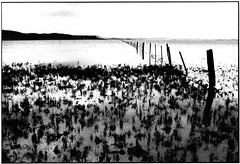

Lake George NSW Australia

Old Lake George, wet version
Lake George NSW Australia
Originally uploaded by sandown
Lake George around 1980, wet version. A now-rare photo of Lake George with water — quite a substantial amount of it too.


lake george

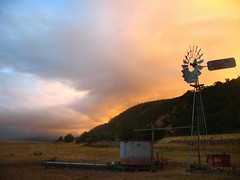
Ridge & windmill, Lake George
lake george
Originally uploaded by omnia
Sunrise behind the wooded ridge.


Australia - Lake George

Lake George - big sky country
Australia - Lake George
Originally uploaded by Celeste33
Lake George isn't in official "big sky country", but sometimes it's just there anyway.
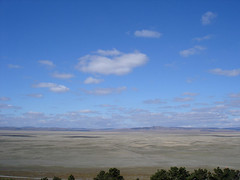

Lake George from its western shore 180d panorama

Panorama and an indigenous opinion, driving north from Canberra


Golden Summer, Lake George

Golden Summer, lake with livestock
Golden Summer, Lake George
Originally uploaded by carlmonus
Art & Life. This lake has livestock.


Lake George (dry lake) just outside Canberra

Mmm. Brings back some of my favourite memories travelling along the border of the lake towards sunset. Just gorgeous.


lake george, canberra

a pale straw plain
lake george, canberra
Originally uploaded by tEE.bEE
Another enduring memory, the pale straw colour of the broad flat grassy plain.
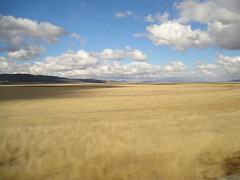

LakeGeorge

LakeGeorge
LakeGeorge
Originally uploaded by totalisator
How lovely it is to watch the clouds come and go, and the shadows and light changing across the 'lake bed' and mountains.


Lake George in sombre mood


A very dramatic version of Lake George by Chris Lane, used with a newspaper story about conflict in the area. 'Gales buffet turbine project', by Wendy Frew in April, 2006


PoD — Lake George

Lake George, clouds
PoD
Originally uploaded by The Department
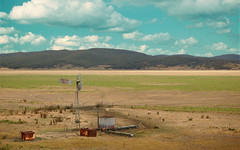
Lake George under fluffy clouds in a high clear sky
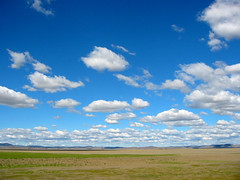

DSC_0016 - Lake George mistier, greyer

This lake has a road across it
DSC_0016
Originally uploaded by DC Maggie
This lake has a road across it. Lake George under a mistier, greyer kind of cloud.
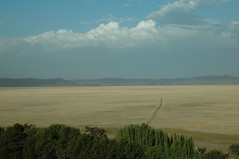

Lake George - dry and sheep grazing in distance

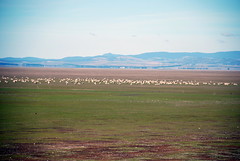
Even more livestock on the lake.

I tried to make a Flickr set out of other people's Flickr photos, couldn't work it out. Tried to set up a link for a search for "George" in my Favourites set, but that only works for me and when I'm signed in. Can't just put in the general "Lake George" and Australia search unless you too want to sort through the hundred or so.

So I'm trying to set up a type of set (heh) by making an entry here with thumbnails of my selected images, which I can link to. An advantage is that I can include non-Flickr images. It'd be nice to have it as a table with 3 or 4 thumbnails across, but for now I'll just have to go with the standard image uploads that Blogger has.

Friday, 12 October 2007

Bogong Moth season in Sydney 2007

Bogongs – first the recipe, now the film!
10 Oct 2007. ABC Sydney. (Australian Broadcasting Corporation):
It's not just the young and foolish attracted to the bright lights of the big city. Swarms of Bogong moths have descended on Sydney during their annual seasonal migration from southern Queensland and northern New South Wales to the alpine region as they migrate to escape the summer heat.
The Herbison-Evans/Crossley story on Agrotis infusa: http://linus.it.uts.edu.au/~don/larvae/noct/infusa.html

Short report with nice pictures from TV news


Long rambling description from a recent resident. Very "actuality"-style camerawork. She seems rather freaked out by the poor little harmless, helpless Agrotis infusa (CSIRO).

Friday, 21 September 2007

Living without memory

The situations that the different people described are in are disturbing and distressing, but what extraordinary things they are capable of, and what strange aspects of knowledge, consciousness and how humans (& perhaps other animals) function their capacities throw some illumination onto.

Sometimes I feel that what I'm aware of as “self” is like a little sailboat scudding along over sunlit wavetops on a wafer-thin surface — a bit like a scale diagram of the biosphere in relation to the size of the earth — while all kinds of life and currents are going on unseen beneath.

A Neurologist’s Notebook

The Abyss

Music and amnesia.
by Oliver Sacks, The New Yorker, September 24, 2007

www.newyorker.com/ reporting/ 2007/ 09/ 24/ 070924fa_fact_sacks?currentPage=1
Clive Wearing now has “a memory span of only seconds – the most devastating case of amnesia ever recorded. New events and experiences were effaced almost instantly … he did not seem to be able to retain any impression of anything for more than a blink. Indeed, if he did blink, his eyelids parted to reveal a new scene. The view before the blink was utterly forgotten …
In addition to this inability to preserve new memories, Clive had a retrograde amnesia, a deletion of virtually his entire past.”

Monday, 23 April 2007

Lipidoptera

This sounds like an example of Lipidoptera, from the ABC Canberra site »
Would you like bogong moths with that? (by Caroline Salisbury, Friday, April 20, 2007)
"The high fat content of bogong moths – 38.8 grams of fat for a 100g portion, more then [sic] three times that of a hamburger, provide an energy dense food for indigenous groups in cold climates".
100g (nearly 4 oz) is the standard amount used on food packaging here to list the amount of things like sodium, fats, sugars, kilojoules, etc. I think you'd need a fair amount of moths to make that up, but in season there'd be feasts.
(Bogong's behaviour is the reason I know the words aestivate, and estivation.)

The rest of the article is quite interesting, about getting standards for eating bush tucker during kidney disease, and the problem of good food in remote areas.
According to Don Herbison-Evans, "a Bogong was unjustly blamed for embarrassing Yvonne Kenny while she was singing the Olympic Hymn in the closing ceremony of the 2000 Sydney Olympic Games, as it landed for a while on her [dress]. In fact there were several moth species including Bogongs attracted to the brilliant arena floodlighting that evening, and the one on Yvonne's dress appeared actually to be a hawk moth of the species Hippotion scrofa."
List of Links
Factsheet: www.csiro.au/ resources/ ps1qn.html
CSIRO pic: www.ento.csiro.au/ ecowatch/ Primary/ butterflies/ pages/ bogong_cluster.htm
Basic Entomology (Sydney Uni): bugs.bio.usyd.edu.au/Entomology/ importance/ imagePages/ bogongMoth.html
Family info fr CSIRO: www.ento.csiro.au/ ecowatch/ Lepidoptera/ noctuidae.htm
ABC scribbly gum on Moth migration: www.abc.net.au/ science/ scribblygum/ november2002/default.htm
page on Unique Australian Animals site: home.iprimus.com.au/ readman/ bogong.htm
Almanac, a big page with assorted November information: www.wilsonsalmanac.com/ book/ nov26.html
short piece from Wildlife of Sydney site: www.faunanet.gov.au/ wos/ factfile.cfm?Fact_ID=204

Friday, 20 April 2007

Thought - one of many

There are some oddities in the perspective with which we see the world. The fact that we live at the bottom of a deep gravity well, on the surface of a gas-covered planet going around a nuclear fireball 90 million miles away and think this to be normal is obviously some indication of how skewed our perspective tends to be,
— Douglas Adams, Digital Biota Cambridge speech, 1998 (www.biota.org/ people/ douglasadams/ index.html)
Quoted in Richard Dawkin's eulogy for Douglas Adams in 2001 (see edge.org/ documents/ adams_index.html )